
Documentary
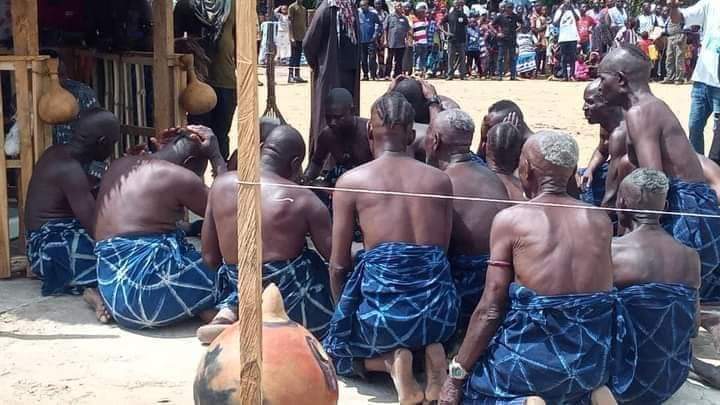
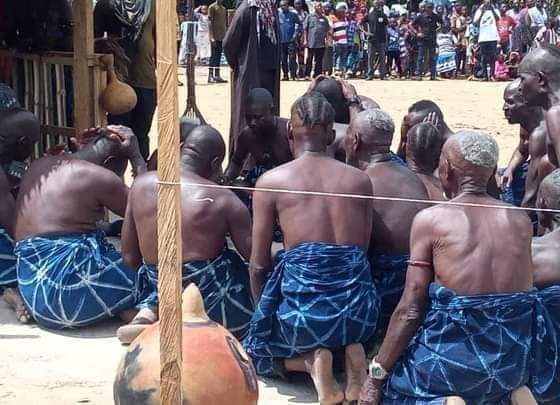
The Eka ( Menstruation) Cultural Practice Of Etulo Ethnic Group Of Benue State

EKA translated in English as MENSTRUATION is a period when a woman is having or experiencing menstrual flow. The Etulo people perceive menstruation as something unclean, with ill luck attached to it and so throughout the period of the flow, the woman is not allowed to sleep under the same roof with her husband, not even in a different room within the same building, hence it is a taboo. She is therefore required to move out of the house or compound to live in a secluded house called EBEKA. The ebeka is usually built in the middle of the compound or mostly behind the compound hence it houses several other women within the extended family that are menstruating.
The menstruating woman is therefore required to remain in the ebeka throughout the period of her menstruation. She eats and sleeps there during and throughout the period of the menstruation. During this period, she is not allowed to go anywhere close to a man or where a group of people are gathered. She is also not expected to eat with anybody except with her little baby where applicable. She at this period eats in a secluded and separate plate and drink from a separate cup other than those used by other members of the family. It is a taboo for her to sit close amidst people. She is also not allowed to cook food for the family consumption during the period. It is considered a taboo and forbidden for her to go close to her husband because as earlier stated, the Etulo people perceive menstruation to be filthy and usually associated with bad or ill luck so her going close to the people, especially her husband would bring bad luck to the husband and entire family. Nothing the husband does will come out good.
Also according to the Etulo culture, the menstruating woman is not allowed to share the same sit with other people in the family or compound, hence she would defile the sit with her uncleanliness during the menstrual period. History has it that in Etulo land, before a man or an elder eat or drink from a compound, he has to be sure there is an EBEKA in that compound otherwise, he would not eat or drink from that compound. This is because he cannot tell if what he’s eating is from a menstruating woman.
Moreso, it is worthy to state that as a consequence, any menstruating woman who fails to observe the EKA cultural practice results to her having continues and ceaseless menstruation until she confesses to her offence and appease the god of cleanliness called OBLEPA. The Oblepa ritual has to be performed before the woman can be cleansed and her health restored to normalcy.
In today’s society however, such tradition as the Eka Cultural practice is no longer prominently in force. This is due to the influence of westernization and the coming of Christianity hence people embrace westernization and Christianity more which is almost sending this cultural norm into extinction. It is no wonder one can hardly find an ebeka in most households in Ikpese Etulo however; a very few families who are more or less custodians of the Etulo tradition still have the ebeka in their compounds and still practice this and uphold the Eka Cultural practice.

Adamawa Govt Pledges Stronger Media Partnership Ahead of 2027 Elections

Governor Fintiri Pardons Nine Inmates, Commutes Death Sentence to Mark Nigeria’s 66th Independence Anniversary In commemoration of Nigeria’s 66th Independence Day celebration, Governor Ahmadu Umaru Fintiri of Adamawa State has granted pardons to nine inmates serving various terms in correctional facilities across the state. A statement issued by the Chief Press Secretary to the Governor, Humwashi Wonosikou, said the Governor ordered the immediate release of the pardoned inmates, noting that all legal formalities had been concluded with the Nigerian Correctional Service. “The Governor acted on the advice of the Advisory Committee on the Prerogative of Mercy and in exercise of the powers conferred on him by Section 212(1)(d) of the Constitution of the Federal Republic of Nigeria, 1999 (as amended),” the statement said. According to the statement, those granted pardon and discharged include Abubakar Dajo, who was serving at the Maximum Security Custodial Centre, Jos; Zabadi Ayuba and Salvation Nyamso, both serving at the Numan Custodial Centre. Others are Amir Idris, Mohammed Saidu, Yaro Sambo, Buhari Salisu, Urube Samuel and Bamaiyi Amos, who were discharged from the Jimeta, Ganye, Guyuk, Yola Old and Kojoli Custodial Centres, respectively. In addition to the pardons, Governor Fintiri approved the commutation of the death sentence imposed on one inmate, Saidu Abdullahi of the Yola Old Custodial Centre, to life imprisonment. The Governor’s action, the statement noted, was in the spirit of the Independence anniversary and reflects the government’s commitment to mercy, justice and the rehabilitation of offenders. The pardons and commutation take immediate effect, the statement added.

Binani Campaign Organization Condemns Babachir Lawal’s “Indecent” Utterances, Calls for Party Discipline

Zare Baba Urges Adamawa First Lady’s Press Crew to Embrace Strategic Communication

Adamawa CPS Urges Journalists to Embrace In-Depth Reporting, Move Beyond “He Said” Style
Adamawa Govt Pledges Stronger Media Partnership Ahead of 2027 Elections
Governor Fintiri Pardons Nine Inmates, Commutes Death Sentence to Mark Nigeria’s 66th Independence Anniversary In commemoration of Nigeria’s 66th Independence Day celebration, Governor Ahmadu Umaru Fintiri of Adamawa State has granted pardons to nine inmates serving various terms in correctional facilities across the state. A statement issued by the Chief Press Secretary to the Governor, Humwashi Wonosikou, said the Governor ordered the immediate release of the pardoned inmates, noting that all legal formalities had been concluded with the Nigerian Correctional Service. “The Governor acted on the advice of the Advisory Committee on the Prerogative of Mercy and in exercise of the powers conferred on him by Section 212(1)(d) of the Constitution of the Federal Republic of Nigeria, 1999 (as amended),” the statement said. According to the statement, those granted pardon and discharged include Abubakar Dajo, who was serving at the Maximum Security Custodial Centre, Jos; Zabadi Ayuba and Salvation Nyamso, both serving at the Numan Custodial Centre. Others are Amir Idris, Mohammed Saidu, Yaro Sambo, Buhari Salisu, Urube Samuel and Bamaiyi Amos, who were discharged from the Jimeta, Ganye, Guyuk, Yola Old and Kojoli Custodial Centres, respectively. In addition to the pardons, Governor Fintiri approved the commutation of the death sentence imposed on one inmate, Saidu Abdullahi of the Yola Old Custodial Centre, to life imprisonment. The Governor’s action, the statement noted, was in the spirit of the Independence anniversary and reflects the government’s commitment to mercy, justice and the rehabilitation of offenders. The pardons and commutation take immediate effect, the statement added.
Binani Campaign Organization Condemns Babachir Lawal’s “Indecent” Utterances, Calls for Party Discipline
Zare Baba Urges Adamawa First Lady’s Press Crew to Embrace Strategic Communication
Adamawa CPS Urges Journalists to Embrace In-Depth Reporting, Move Beyond “He Said” Style
Adamawa Govt Pledges Stronger Media Partnership Ahead of 2027 Elections
Governor Fintiri Pardons Nine Inmates, Commutes Death Sentence to Mark Nigeria’s 66th Independence Anniversary In commemoration of Nigeria’s 66th Independence Day celebration, Governor Ahmadu Umaru Fintiri of Adamawa State has granted pardons to nine inmates serving various terms in correctional facilities across the state. A statement issued by the Chief Press Secretary to the Governor, Humwashi Wonosikou, said the Governor ordered the immediate release of the pardoned inmates, noting that all legal formalities had been concluded with the Nigerian Correctional Service. “The Governor acted on the advice of the Advisory Committee on the Prerogative of Mercy and in exercise of the powers conferred on him by Section 212(1)(d) of the Constitution of the Federal Republic of Nigeria, 1999 (as amended),” the statement said. According to the statement, those granted pardon and discharged include Abubakar Dajo, who was serving at the Maximum Security Custodial Centre, Jos; Zabadi Ayuba and Salvation Nyamso, both serving at the Numan Custodial Centre. Others are Amir Idris, Mohammed Saidu, Yaro Sambo, Buhari Salisu, Urube Samuel and Bamaiyi Amos, who were discharged from the Jimeta, Ganye, Guyuk, Yola Old and Kojoli Custodial Centres, respectively. In addition to the pardons, Governor Fintiri approved the commutation of the death sentence imposed on one inmate, Saidu Abdullahi of the Yola Old Custodial Centre, to life imprisonment. The Governor’s action, the statement noted, was in the spirit of the Independence anniversary and reflects the government’s commitment to mercy, justice and the rehabilitation of offenders. The pardons and commutation take immediate effect, the statement added.
Binani Campaign Organization Condemns Babachir Lawal’s “Indecent” Utterances, Calls for Party Discipline
Zare Baba Urges Adamawa First Lady’s Press Crew to Embrace Strategic Communication