
News
After the Flood: Questions Trail Relief Distribution in Yola Communities

By Semen Isaiah Lerum
yola_August 02,2025
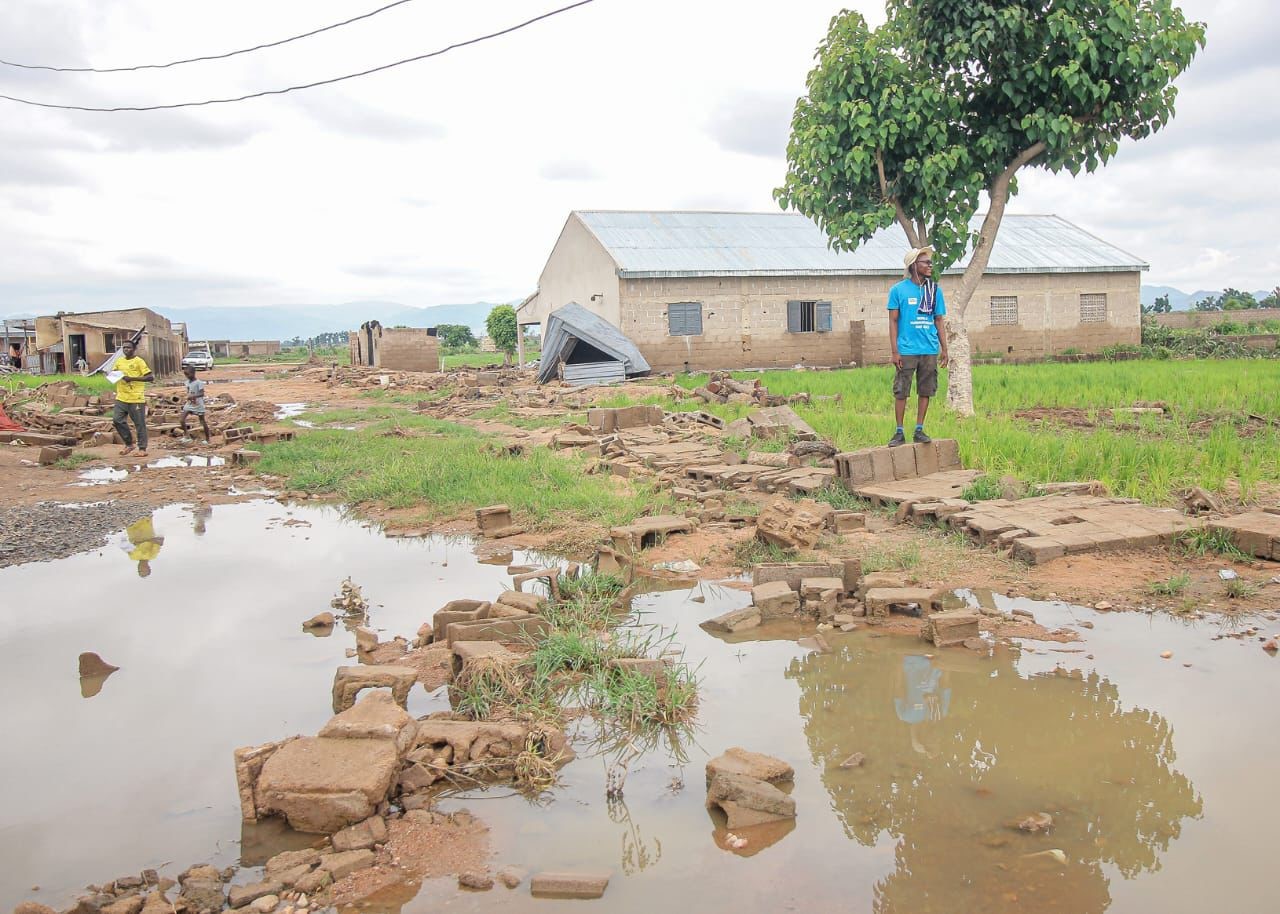
On July 27, 2025, severe flooding affected the communities of Shagari, Yolde Pate, and Sabon Pegi in Yola, Adamawa State. What began as heavy rainfall quickly escalated into a flood disaster.
At least 25 lives were lost, 11 persons remain unaccounted for, and 5,560 individuals were displaced According to the National Emergency Management Agency (NEMA) . The agency also confirmed that approximately 927 households were impacted, with 524 completely displaced. Homes were submerged, farmlands destroyed, and properties washed away.
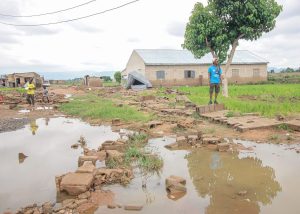
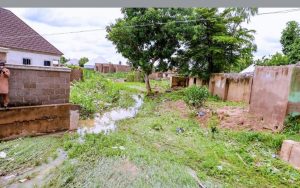
Sabon pegi community after the flood
The Adamawa State Government established a temporary displacement camp at Aliyu Mustapha College, a public secondary school in Yola South in response to the disaster . Security personnel were deployed to ensure order and safety, and a public announcement was made urging flood victims to register at the camp for humanitarian response.
However, the humanitarian response faced early strain. The entry of non-affected individuals seeking relief services created additional pressure on available resources and complicated the registration process. For this reason, the government has asked all the victims to return to their homes and vacate the camp, stating that any further interventions will be carried out within their respective communities.
In the immediate aftermath, politicians, private individuals and non-governmental organizations visited affected communities with flood relief matrerials.
While some residents confirm receiving assistance, others say they were left out.
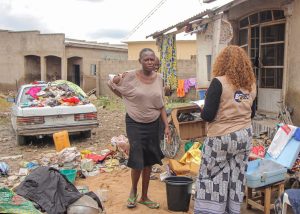
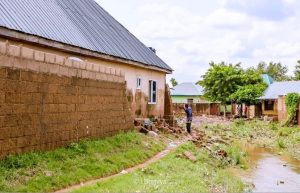
A humanitarian worker assesses a flood victim outside her damaged home in Yola.
During a visit to one of the affected communities, at Sabon pegi a resident who asked to be identified as Mary said distribution efforts were not evenly coordinated.
“People came to distribute items, but it was not properly organized,” she said. “Some streets received support while others did not. My area did not receive anything.”
She also recalled challenges during their stay at the temporary camp.
“It the camp, they shared food and other materials, but it almost resulted in a fight. There was confusion. Some people collected items more than once, while some of us went back without anything,” she said.
Her concerns raise questions about how relief materials were managed at community level.
In many neighborhoods, distribution was reportedly handed over to ward leaders, locally known as Mai Angwan, who were expected to oversee fair allocation among affected residents.
When contacted, one ward leader, Mr. Musa, (not his real name) confirmed that relief materials were initially brought to him for distribution.
“At the beginning, some relief items were handed over to me to distribute to victims in my ward, and I carried out that responsibility,” he said. “We worked with community members to ensure the most affected people were reached.”
However, he explained that the arrangement later changed.
“After some time, they stopped bringing materials to me directly,” he said. “Some NGOs preferred to distribute house to house. They informed me before coming, and I asked them to go ahead. In some cases, I even joined them during the distribution.”
According to Mr. Musa, the state government had indicated that broader distribution of officially received donations would follow a structured process.
“We were told that all donations coming to the government would not be shared immediately,” he said. “Proper data had to be collected first. The government said there would be an official flag-off once the data was complete.”
He added that distributions currently taking place directly in homes without ward coordination were likely carried out by private donors, NGOs or individuals acting independently.
To carify the process, the Adamawa State Emergency Management Agency was contacted. A representative explained that the government adopted a phased response.
According to the agency, immediate assistance focused on emergency shelter and basic relief. After that phase, officials began compiling verified records of affected households to guide the larger distribution of donations received by the state.
“We are documenting affected families and assessing damages before full-scale distribution,” the official said. “This is to ensure transparency and avoid duplication.”
When asked about documentation, the agency confirmed that beneficiary lists and assessment records are being compiled in collaboration with community leaders. However, detailed breakdowns of total donations received and distribution records were not immediately made available at the time of this report.
The agency also clarified that distributions conducted independently by NGOs or private individuals may not be part of the government’s centralized coordination system.
Beyond immediate aid, the flooding underscores a deeper need for stronger disaster preparedness systems in Yola. Early warning communication, improved drainage infrastructure, pre-disaster vulnerability mapping, and clearly defined coordination channels between state agencies, ward leaders, and humanitarian actors could prevent similar challenges in future crises.
For now, many families are back in their homes, salvaging what they can and waiting for promised assistance. Whether the recovery effort restores not only livelihoods but also public confidence will depend on how transparently and equitably the next phase of relief unfolds.
In the aftermath of disaster, rebuilding trust can be just as important as rebuilding homes.
Flood Affected communities in yola












Ronaldo Flees Saudi Arabia With Family, Goes To Spain After Airstrikes In Riyadh

FINTIRI TO HOST 2,000 FOR RAMADAN IFTAR AT MAHMUD RIBADU SQUARE

Adamawa CAN Backs Governor Fintiri’s Political Defection

Fintiri to Host 2,000 for Historic Ramadan Iftar at Mahmud Ribadu Square

How Community Theatre Opened Dialogue in Conflict-Affected Areas in Adamawa
Ronaldo Flees Saudi Arabia With Family, Goes To Spain After Airstrikes In Riyadh
FINTIRI TO HOST 2,000 FOR RAMADAN IFTAR AT MAHMUD RIBADU SQUARE
Adamawa CAN Backs Governor Fintiri’s Political Defection
Fintiri to Host 2,000 for Historic Ramadan Iftar at Mahmud Ribadu Square
How Community Theatre Opened Dialogue in Conflict-Affected Areas in Adamawa
Ronaldo Flees Saudi Arabia With Family, Goes To Spain After Airstrikes In Riyadh
FINTIRI TO HOST 2,000 FOR RAMADAN IFTAR AT MAHMUD RIBADU SQUARE
Adamawa CAN Backs Governor Fintiri’s Political Defection
Fintiri to Host 2,000 for Historic Ramadan Iftar at Mahmud Ribadu Square